
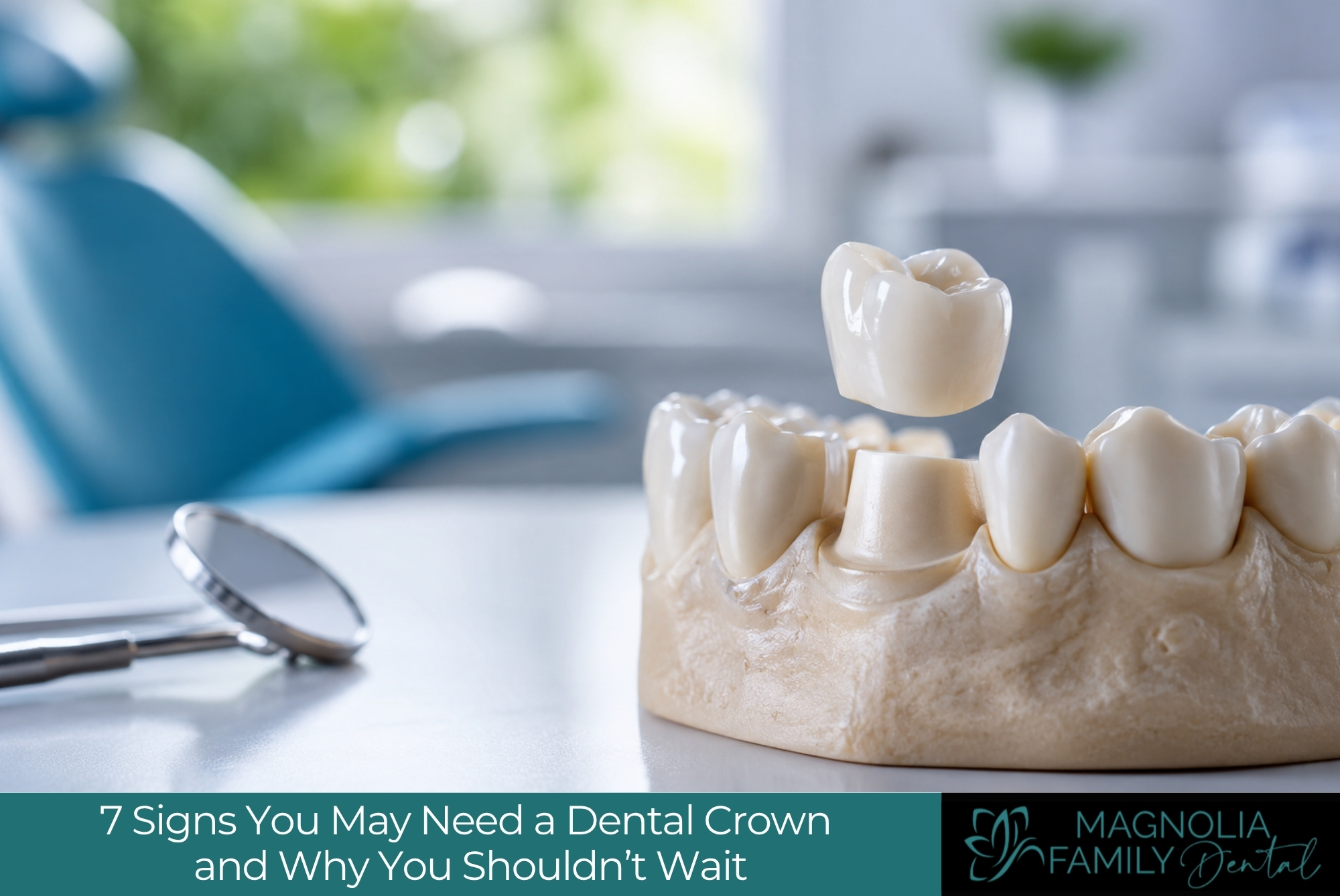
 Your teeth are designed to withstand years of biting, chewing, and everyday use, but they are not indestructible. Decay, fractures, large fillings, dental trauma, and normal wear can gradually weaken a tooth until it needs additional protection. In many cases, a dental crown can restore the tooth’s strength, appearance, and function while helping prevent more serious dental problems.
At Magnolia Family Dental, patients looking for dental crowns in Gainesville, FL can receive personalized restorative dental care designed to preserve natural teeth whenever possible. Recognizing the warning signs of a weakened or damaged tooth can help you seek treatment before the problem progresses.
Here are seven signs that may indicate it is time to talk with your dentist about a dental crown.
What Is a Dental Crown?
A dental crown is a custom-made restoration designed to cover the visible portion of a damaged, weakened, or significantly restored tooth. Sometimes called a “cap,” a crown surrounds the tooth to provide additional strength and protection while restoring its natural shape and function.
What Problems Can Dental Crowns Address?
Dentists may recommend crowns for teeth affected by significant decay, fractures, large fillings, extensive wear, or structural weakness. Crowns are also frequently used following root canal treatment and as the visible restoration attached to certain dental implants.
Depending on the clinical situation and the material selected, a crown can also closely resemble a natural tooth in size, shape, and color.
1. You Have a Cracked or Fractured Tooth
A crack is one of the most important reasons to have a tooth evaluated promptly. Cracks can occur because of trauma, biting hard foods or objects, teeth grinding, large existing fillings, or gradual weakening of the tooth.
Why a Cracked Tooth Can Become a Bigger Problem
A tooth does not heal a structural crack the way a bone can heal a fracture. Depending on its location and severity, a crack may gradually extend farther into the tooth.
Some cracks cause obvious pain, while others initially produce few symptoms. You might notice discomfort when chewing, sensitivity to hot or cold temperatures, or pain when releasing your bite.
When enough healthy tooth structure remains, placing a crown over a cracked tooth may help stabilize and protect it from additional damage.
2. You Have a Large Filling That Is Weakening the Tooth
Dental fillings are effective for repairing cavities, but very large fillings can leave relatively little natural tooth structure surrounding the restoration.
When a Filling May No Longer Provide Enough Support
As fillings become larger, the remaining walls of the tooth may become more susceptible to fractures. Older fillings can also wear, loosen, crack, or develop gaps over time.
If a significant portion of a tooth has already been restored, your dentist may recommend a crown instead of simply replacing the filling again.
A crown covers and reinforces the tooth rather than filling only the damaged area.
3. Your Tooth Has Significant Decay
Small to moderate cavities can often be treated with fillings. When decay destroys a substantial amount of tooth structure, however, a filling may not provide sufficient strength.
Crowns Can Restore Teeth After Extensive Decay
Treatment generally begins by removing the decayed tooth structure. If enough healthy tooth remains, a crown can then protect the weakened tooth and restore its function.
Delaying treatment allows decay to continue progressing. Once bacteria reach the dental pulp—the soft tissue containing nerves and blood vessels inside the tooth—the patient may require root canal treatment. In severe cases, a tooth may eventually become non-restorable and require extraction.
Early diagnosis can provide more opportunities to preserve natural tooth structure.
4. Your Tooth Is Worn Down
Teeth can gradually become shorter, flatter, chipped, or otherwise worn.
Common contributors to excessive tooth wear include teeth grinding or clenching, an uneven bite, acidic foods and beverages, and certain medical or dental conditions.
Why Excessive Tooth Wear Matters
Tooth enamel is the hardest substance in the human body, but once significant enamel is lost, it does not naturally regenerate.
Advanced wear may cause sensitivity, changes in bite alignment, cosmetic concerns, or weakened teeth.
Crowns may be incorporated into a restorative treatment plan when individual teeth have lost substantial structure. However, your dentist will also want to determine why the wear occurred so the underlying cause can be addressed.
For example, patients who grind their teeth may benefit from additional preventive strategies to help protect both their natural teeth and new restorations.
5. You Recently Had a Root Canal
Root canal treatment can save a tooth when its pulp becomes infected, inflamed, or irreversibly damaged.
After treatment, however, some teeth—particularly molars and premolars that absorb significant chewing forces—may need additional structural protection.
Why Crowns Are Often Recommended After Root Canal Treatment
The need for a crown depends on the tooth’s location and the amount of healthy structure remaining.
Back teeth frequently benefit from full-coverage restorations because they experience substantial biting pressure. A crown can help protect the treated tooth from fracture while restoring normal chewing function.
If your dentist recommends a crown after a root canal, completing the final restoration is an important part of the overall treatment process.
6. Your Tooth Hurts When You Bite or Chew
Pain while chewing should not be ignored. Although several dental conditions can cause biting discomfort, structural damage to a tooth is one possibility.
What Does Pain When Biting Mean?
Chewing pain can potentially be associated with a cracked tooth, decay, a damaged filling, inflammation around the tooth, or problems involving the dental pulp.
Because several conditions can produce similar symptoms, a dental examination is necessary to determine the cause.
If the discomfort results from a weakened or cracked tooth that can still be restored, a dental crown may be one treatment option.
7. Part of Your Tooth Has Broken Off
If a piece of your tooth suddenly breaks, it is important to schedule a dental evaluation even when you are not experiencing significant pain.
A Broken Tooth May Still Be Repairable
Whether a broken tooth can be restored depends on how much structure was lost, where the fracture occurred, the health of the tooth’s root and pulp, and whether sufficient healthy structure remains to support a restoration.
For teeth that are still restorable, a crown may help rebuild the missing structure and protect the remaining tooth.
Prompt evaluation is important because additional pieces of an already weakened tooth can potentially fracture.
Why You Shouldn’t Wait If You Think You Need a Dental Crown
Dental problems rarely become simpler when they are allowed to progress untreated.
A small crack can become larger. Decay can extend deeper into the tooth. A weakened cusp can fracture. A compromised filling can fail.
Early Treatment May Help Preserve Your Natural Tooth
One of the primary goals of restorative dentistry is to maintain healthy natural teeth whenever reasonably possible.
Treating a compromised tooth while it remains restorable may prevent the need for more extensive treatment later.
Waiting until a tooth becomes severely painful is not a reliable strategy because some significant dental problems can initially cause little or no discomfort.
What Happens If You Delay Getting a Dental Crown?
The consequences depend on why the crown was recommended.
A weakened tooth may fracture further. Untreated decay may reach the pulp. A cracked tooth may become increasingly difficult to restore. A tooth that has undergone root canal therapy may remain vulnerable to structural damage if its recommended final restoration is not completed.
In some circumstances, delaying care can ultimately result in losing a tooth that might previously have been restorable.
Benefits of Dental Crowns
When appropriately recommended, dental crowns can provide both functional and aesthetic benefits.
Protecting Weakened Teeth
A crown surrounds the visible portion of a tooth, helping distribute chewing forces and reinforce compromised tooth structure.
Restoring Normal Function
A damaged tooth can make chewing uncomfortable or difficult. A properly designed crown restores the tooth’s shape and helps it function more normally within the bite.
Improving Appearance
Tooth-colored crowns can be designed to complement surrounding teeth. They may improve the appearance of teeth that are severely discolored, misshapen, fractured, or extensively restored.
Preserving Natural Teeth
Perhaps most importantly, a crown can sometimes make it possible to retain a natural tooth that otherwise remains vulnerable to further damage.
What to Expect When Getting a Dental Crown
The specific process depends on your individual needs and the restorative system being used.
Dental Examination
Your dentist first evaluates the tooth, surrounding tissues, and bite. Dental X-rays may be recommended to assess structures that cannot be seen during a visual examination.
Preparing the Tooth
Damaged or decayed tooth structure is removed as needed, and the remaining tooth is carefully shaped to accommodate the crown.
In some cases, additional restorative material may be necessary to rebuild portions of the tooth before crown placement.
Designing the Crown
Measurements or impressions are obtained so the crown can be fabricated to fit your tooth and bite.
Crown Placement
Once the final crown is ready, your dentist evaluates its fit, contacts with neighboring teeth, bite, and appearance before securing it in place.
How Long Do Dental Crowns Last?
There is no universal lifespan for every dental crown. Longevity depends on factors including the crown material, oral hygiene, bite forces, tooth location, diet, grinding or clenching habits, and the health of the supporting tooth and gums.
How Can You Protect Your Crown?
Good oral hygiene remains essential because the natural tooth underneath the crown can still develop decay, particularly near the crown margin.
Brush twice daily with fluoride toothpaste, clean between your teeth every day, attend regular dental examinations and cleanings, and avoid using your teeth to open packages or chew extremely hard objects.
Patients who grind or clench their teeth should discuss appropriate protection with their dentist.
Dental Crowns vs. Fillings: What’s the Difference?
Both fillings and crowns restore damaged teeth, but they do so differently.
Dental Fillings
A filling replaces a relatively localized area of tooth structure lost to decay or damage.
Dental Crowns
A crown covers most or all of the visible portion of the tooth and provides more extensive structural protection.
Your dentist determines which restoration is appropriate based on the amount of healthy tooth remaining, location of the damage, bite forces, and other clinical factors.
Dental Crowns in Gainesville, FL
If you have a cracked, broken, heavily filled, worn, or extensively decayed tooth, waiting for symptoms to become severe could allow additional damage to occur.
At Magnolia Family Dental, patients seeking dental crowns in Gainesville, FL can receive a comprehensive evaluation to determine whether a crown or another restorative treatment is appropriate.
The objective is not simply to cover a damaged tooth. Effective restorative dentistry considers the health of the tooth, its function within your bite, surrounding gum tissue, aesthetics, and long-term prognosis.
Frequently Asked Questions About Dental Crowns
How do I know if I actually need a dental crown?
Only a dental examination can determine whether a crown is appropriate. Common reasons include extensive decay, a large existing filling, fractures, significant wear, or the need to protect certain teeth following root canal treatment.
Does getting a dental crown hurt?
Local anesthesia is typically used while the tooth is being prepared, helping keep patients comfortable during treatment. Temporary sensitivity or gum tenderness can sometimes occur afterward.
Can a cracked tooth always be saved with a crown?
No. Whether the tooth can be saved depends on the location, direction, and extent of the crack. Some cracks can be stabilized with restorative treatment, while fractures extending deeply into the root may make the tooth impossible to predictably restore.
Can I get another filling instead of a crown?
Sometimes. The appropriate restoration depends on how much healthy tooth structure remains and the amount of support the tooth needs. When a tooth has been extensively damaged or restored, another filling may not provide adequate protection.
Do crowns look like natural teeth?
Modern tooth-colored crowns can be designed to closely complement surrounding teeth in shape, size, and shade. The final appearance depends on factors including crown material, tooth position, and individual anatomy.
Can you get a cavity underneath a crown?
Yes. A crown itself cannot develop a cavity, but the natural tooth underneath it can. Decay commonly develops near the margin where the crown meets the tooth, which is why brushing, interdental cleaning, and regular dental examinations remain important.
What should I do if my crown comes off?
Contact your dentist promptly and keep the crown if you can find it. Avoid attempting to permanently glue the crown back onto your tooth yourself. The dentist will need to evaluate both the restoration and the underlying tooth.
Is a crown necessary after every root canal?
Not necessarily. The need for a crown depends on which tooth received treatment and how much healthy structure remains. Molars and premolars frequently require greater structural protection because they experience substantial chewing forces.
How quickly should I get a crown after my dentist recommends one?
The urgency depends on the condition of the tooth. A significantly cracked or structurally compromised tooth may require prompt treatment because further fracture could affect whether it remains restorable. Follow the treatment timeline recommended by your dentist.
What happens if I ignore a broken tooth because it doesn’t hurt?
A lack of pain does not necessarily mean a broken tooth is healthy. Additional fractures, decay, or pulp involvement can occur without immediate severe symptoms. A dentist should evaluate a broken tooth to determine the extent of the damage.
Can a crown help with tooth sensitivity?
It may when sensitivity is related to certain types of structural damage or extensive loss of tooth structure. However, sensitivity has many possible causes, so an examination is necessary before determining the appropriate treatment.
How do I know whether I need a crown or a root canal?
They address different problems. Root canal therapy treats damaged or infected pulp inside a tooth, while a crown primarily restores and protects the tooth’s external structure. Some teeth require a crown without a root canal, while others require both procedures.
Are dental crowns only for older adults?
No. Adults of many ages may need crowns because of decay, trauma, fractures, large fillings, root canal treatment, excessive wear, or other structural concerns.
Should I replace an old crown if it doesn’t hurt?
Not necessarily. A crown should be evaluated based on its fit, integrity, the health of the underlying tooth, surrounding gums, and other clinical findings—not age alone. Regular dental examinations allow your dentist to monitor existing restorations for changes.
Protect a Damaged Tooth Before the Problem Gets Worse
Cracked, weakened, and heavily restored teeth deserve attention even when they are not causing constant pain. Addressing structural problems early may provide more options for preserving your natural tooth and avoiding more complicated treatment.
If you are experiencing pain when chewing, have broken a tooth, have a large or failing filling, or have been told that your tooth needs additional protection, schedule an evaluation with Magnolia Family Dental.
For patients searching for dental crowns in Gainesville, FL, Magnolia Family Dental provides restorative dental care focused on protecting oral health, restoring comfortable function, and helping natural teeth remain healthy for as long as possible.
Contact Information
Magnolia Family Dental
4121 NW 37th Place
Gainesville, FL 32606
Phone: (352) 373-7361
Website: magnoliafamilydental.com
Appointments: magnoliafamilydental.com/appointments/