
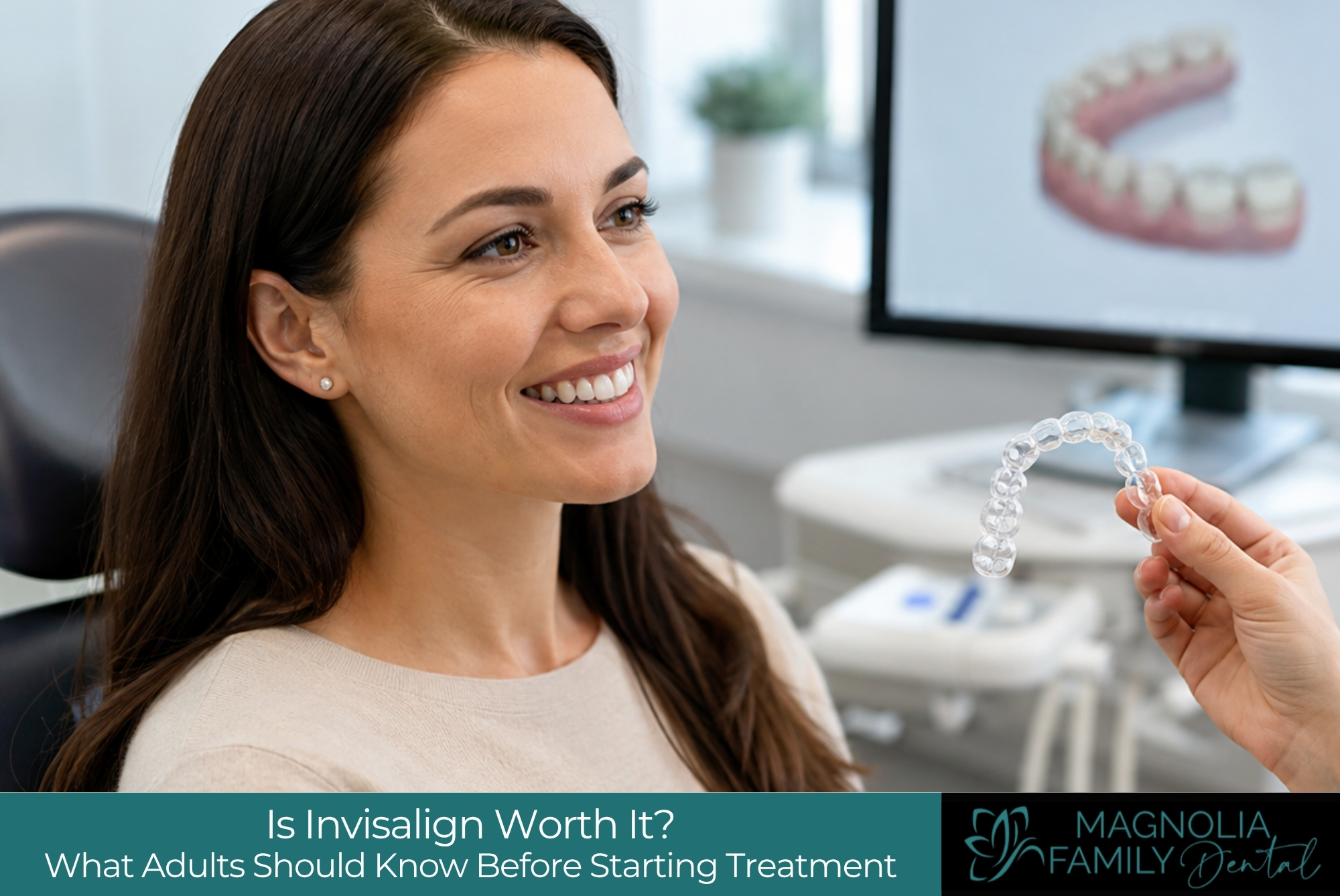
 For many adults, the idea of improving their smile is appealing, but the thought of wearing traditional metal braces may make them hesitant to pursue orthodontic treatment. Invisalign® clear aligners have changed that conversation by providing adults with a discreet, removable approach to straightening their teeth.
If you are researching Invisalign in Gainesville, FL, you may be wondering whether the treatment is truly worth the investment. The answer depends on your dental needs, lifestyle, treatment goals, and willingness to follow your treatment plan.
At Magnolia Family Dental, patients can receive a professional evaluation to determine whether Invisalign is appropriate for their smile. Understanding how treatment works—and what it requires from you—can help you make an informed decision.
What Is Invisalign?
Understanding Clear Aligner Therapy
Invisalign is an orthodontic treatment that uses a customized series of clear, removable aligners to gradually reposition teeth. Instead of brackets and wires, the aligners fit over the teeth and apply controlled forces designed to produce specific tooth movements.
The American Association of Orthodontists (AAO) describes clear aligners as thin, custom-formed trays that sequentially move teeth. Clear aligners can be used for a variety of orthodontic concerns, although their suitability depends on the individual patient’s diagnosis and treatment needs.
What Can Invisalign Correct?
Depending on the individual case, clear aligner therapy may be considered for conditions such as:
- Crowded teeth
- Crooked or rotated teeth
- Gaps and unwanted spacing
- Overbite
- Underbite
- Crossbite
- Open bite
- Certain other bite-alignment concerns
Clear aligners are increasingly capable of treating a broad range of orthodontic problems, but they are not automatically the best choice for every patient. A dental examination and individualized treatment plan are important before beginning treatment.
Is Invisalign Worth It for Adults?
The Value Goes Beyond Appearance
For the right patient, Invisalign can be a worthwhile investment because orthodontic treatment isn’t exclusively cosmetic.
Proper tooth alignment can contribute to healthier function and may make it easier to effectively brush and floss certain areas. The AAO notes that misaligned teeth may contribute to concerns such as excessive tooth wear, difficulty maintaining oral hygiene, and problems with chewing.
Adults considering Invisalign in Gainesville, FL should therefore think about treatment as an investment in both their smile and long-term dental health.
Discreet Treatment for Adult Lifestyles
One of Invisalign’s biggest advantages is appearance. The aligners are clear and designed to be relatively inconspicuous.
For adults who routinely attend meetings, interact with customers, speak publicly, attend social events, or simply don’t want highly visible orthodontic appliances, this can make treatment more appealing.
Invisalign treatment may be especially attractive for professionals and adults who previously avoided orthodontics because they didn’t want conventional braces.
Why More Adults Are Choosing Orthodontic Treatment
Orthodontics Isn’t Just for Teenagers
There is no age cutoff for wanting a healthier, straighter smile. According to the American Dental Association, healthy teeth can undergo orthodontic treatment at any age.
The AAO also reports that approximately one in three orthodontic patients today are adults, reflecting the growing popularity and acceptance of adult orthodontic care.
Whether your teeth have always been crooked, have gradually shifted over time, or moved after previous orthodontic treatment, adulthood doesn’t necessarily prevent you from improving your alignment.
How Invisalign Treatment Works
Step 1: Your Invisalign Consultation
The process starts with an evaluation of your teeth, gums, bite, and overall oral health.
This step is important because successful orthodontic treatment involves more than simply making the front teeth look straighter.
Your dentist must consider how the teeth fit together, periodontal health, existing dental restorations, tooth position, and other factors before recommending treatment.
Step 2: Creating Your Treatment Plan
If you are a suitable Invisalign candidate, detailed records of your teeth can be used to develop your customized treatment plan.
The aligners are then manufactured to gradually guide your teeth toward their planned positions.
Step 3: Wearing Your Aligners
You’ll progress through a series of aligners during treatment.
Clear aligners generally need to be worn most of the day and night. Invisalign states that patients should typically wear their aligners approximately 20–22 hours per day.
They are usually removed for eating, drinking beverages other than water, brushing, and flossing.
Step 4: Monitoring Your Progress
Orthodontic tooth movement needs professional supervision.
Follow-up appointments allow your dental provider to evaluate whether your teeth are moving as planned and make changes when necessary.
Professional monitoring is an important distinction between doctor-supervised Invisalign treatment and unsupervised approaches to moving teeth.
The Biggest Benefits of Invisalign for Adults
Invisalign Is Removable
Unlike traditional braces, Invisalign aligners can be removed.
That means you can take them out for meals and continue eating many of your favorite foods without having to navigate brackets and wires.
Brushing and Flossing Are Easier
Because the trays are removable, patients can brush and floss without having to clean around fixed orthodontic brackets.
However, good oral hygiene becomes especially important because teeth should be clean before the aligners are placed back into the mouth.
There Are No Traditional Metal Brackets or Wires
Some adults prefer Invisalign because it eliminates the brackets and wires associated with conventional braces.
The smooth aligner design may also reduce some of the irritation associated with fixed orthodontic hardware.
Treatment Is Less Noticeable
For many adults, this is the deciding factor.
Clear aligners allow patients to pursue orthodontic treatment without making their treatment the first thing other people notice about their smile.
What Adults Need to Know Before Choosing Invisalign
Invisalign Requires Commitment
Removability is simultaneously one of Invisalign’s greatest advantages and one of its biggest challenges.
Traditional braces remain attached to your teeth. Invisalign doesn’t.
If you repeatedly leave your aligners out for extended periods, treatment may not progress according to plan.
Invisalign works best for patients who are prepared to consistently follow their prescribed wear schedule.
You Have to Remove Aligners Before Eating
Your aligners should generally be removed when eating.
For adults who frequently snack throughout the day, this can require a lifestyle adjustment.
You need to develop a routine of removing the trays, storing them safely, eating, cleaning your teeth as appropriate, and putting the aligners back in.
You May Experience Temporary Pressure or Tenderness
Orthodontic treatment works by applying forces to teeth, so some pressure or temporary tenderness can occur.
Patients may notice tightness when transitioning to a new set of aligners. Invisalign reports that this initial discomfort commonly subsides after a short period.
Attachments May Be Necessary
Although Invisalign is often described as virtually invisible, some patients require small tooth-colored attachments.
These attachments provide additional surfaces for the aligners to engage, helping create specific tooth movements.
Whether attachments are necessary depends on the individual treatment plan.
How Long Does Invisalign Take?
Treatment Time Is Different for Every Patient
There isn’t one universal Invisalign treatment timeline.
Your treatment length can depend on factors including:
- Severity of crowding or spacing
- Complexity of your bite
- Number and type of tooth movements required
- Consistency with wearing aligners
- How your teeth respond to treatment
- Whether additional refinement aligners are necessary
Some relatively straightforward cases may be completed in a matter of months, while more complicated cases may require considerably longer.
Invisalign reports that some patients may see final results in as little as six months, but emphasizes that treatment time varies according to case complexity and individual circumstances.
Your dentist can provide a more meaningful estimate after evaluating your teeth.
Invisalign vs. Traditional Braces
Which Option Is Better?
There isn’t a universal winner.
The better orthodontic treatment is the one that can safely and predictably address your individual condition.
Invisalign may offer advantages such as:
- Discreet appearance
- Removability
- Easier access for brushing and flossing
- Fewer dietary restrictions
- No traditional metal brackets or wires
Traditional braces, however, remain an excellent orthodontic treatment and may be recommended for certain complex tooth movements or bite problems.
The AAO emphasizes that clear aligners aren’t appropriate for everyone and that some cases can be treated more predictably using braces.
Is Invisalign More Expensive Than Braces?
Understanding the Cost of Treatment
The cost of Invisalign varies because every treatment plan is different.
Factors that may influence cost include:
- Complexity of your orthodontic condition
- Length of treatment
- Number of aligners required
- Additional treatment needs
- Insurance benefits
- Provider and treatment-plan considerations
Invisalign states that the cost of its treatment is often comparable to braces, although the final amount depends on the complexity of the individual case.
Rather than comparing treatment solely by price, adults should consider overall value, including convenience, aesthetics, professional supervision, expected treatment time, and long-term results.
Does Dental Insurance Cover Invisalign?
Your Benefits Depend on Your Plan
Some dental insurance plans provide orthodontic benefits that may apply to Invisalign treatment.
Coverage varies significantly by plan. There may be:
- Lifetime orthodontic maximums
- Age limitations
- Deductibles
- Percentage-based coverage
- Waiting periods
- Other restrictions
Invisalign also notes that eligible patients may be able to use Health Savings Account (HSA) or Flexible Spending Account (FSA) funds toward treatment.
Patients should review their individual insurance benefits rather than assuming Invisalign is or isn’t covered.
Who Is a Good Candidate for Invisalign?
Adults With Healthy Teeth and Gums
Before orthodontic treatment begins, existing oral health concerns should be evaluated.
Healthy gums and adequate dental health are particularly important because orthodontic treatment physically moves teeth through the supporting structures.
The AAO stresses the importance of evaluating periodontal health before tooth movement because moving teeth in the presence of poor periodontal health can increase the risk of complications.
Adults Who Will Follow Instructions
The ideal Invisalign patient understands that treatment requires participation.
You should be prepared to:
- Wear your aligners as directed
- Remove them appropriately for meals
- Maintain excellent oral hygiene
- Keep your aligners clean
- Attend scheduled appointments
- Change aligners according to instructions
- Wear retainers after active treatment
Patient compliance is an essential part of clear aligner therapy.
Who May Not Be an Ideal Invisalign Candidate?
Invisalign and other clear aligners can treat many orthodontic conditions, but not every case is best managed with aligners alone.
Patients with certain complicated bite relationships, severe tooth-position problems, significant periodontal disease, or other dental concerns may need alternative or additional treatment.
The only reliable way to determine candidacy is through a professional dental evaluation.
What Happens After Invisalign?
Retainers Are an Essential Part of Treatment
Finishing your final Invisalign tray doesn’t necessarily mean your orthodontic journey is finished.
Teeth have a natural tendency to shift after orthodontic movement. Retainers help maintain the new positions of the teeth.
Your dentist will recommend a retention schedule based on your individual situation.
Failing to wear your retainer as directed can allow your teeth to gradually shift, potentially compromising the results you’ve worked to achieve.
Is Invisalign Worth the Investment?
For many adults, yes.
Invisalign may be particularly worthwhile if you:
- Have always wanted straighter teeth
- Are uncomfortable with your smile
- Want a discreet orthodontic option
- Prefer removable appliances
- Want fewer food restrictions than traditional braces
- Are committed to wearing aligners consistently
- Want to address certain alignment or bite concerns
- Value the convenience of removable orthodontic treatment
However, Invisalign’s value depends on whether it is clinically appropriate for you and whether you’re prepared to follow your treatment plan.
The goal shouldn’t simply be to purchase clear aligners. The goal should be to achieve a healthier, more functional, confident smile through properly planned and professionally supervised orthodontic care.
Choosing Invisalign in Gainesville, FL
Start With a Professional Evaluation
If you’re considering Invisalign in Gainesville, FL, your first step should be a comprehensive consultation.
At Magnolia Family Dental, your dental team can evaluate your teeth, bite, oral health, and smile goals to determine whether Invisalign may be appropriate for you.
This evaluation is also your opportunity to ask questions about expected treatment length, aligner wear, cost, insurance, attachments, retainers, and what results may realistically be achieved in your particular case.
Frequently Asked Questions About Invisalign
Is Invisalign really worth it for adults?
For many adults, Invisalign can be a worthwhile investment because it offers an effective and discreet way to pursue orthodontic improvement without traditional brackets and wires. Whether it is worth it for you depends on your orthodontic needs, expectations, budget, and ability to consistently wear your aligners.
Am I too old for Invisalign?
Age alone doesn’t necessarily prevent adults from undergoing orthodontic treatment. The ADA notes that healthy teeth can be orthodontically treated at any age.
Your dental and periodontal health are generally more important considerations than your chronological age.
How many hours per day do I need to wear Invisalign?
Invisalign generally recommends wearing the aligners for approximately 20–22 hours per day. Your provider will give you instructions based on your individual treatment plan.
Can I eat while wearing Invisalign?
Aligners should generally be removed before eating. One advantage of removable aligners is that you don’t have the same food restrictions typically associated with traditional braces.
Can I drink coffee with Invisalign?
It’s generally best to remove your aligners when drinking beverages other than water unless your dental provider instructs you otherwise. Coffee can potentially discolor aligners, and beverages trapped between aligners and teeth may create oral-health concerns.
Will Invisalign affect my speech?
Some patients notice a temporary change in speech when they first begin wearing aligners. The tongue usually adapts as the patient becomes accustomed to wearing the trays.
Does Invisalign hurt?
Some temporary pressure or tenderness can occur, particularly when switching to a new aligner. This sensation is associated with the forces being applied to move the teeth and often improves as you adjust to each tray.
Are Invisalign results permanent?
Orthodontic results can be long-lasting, but teeth may shift over time without proper retention. Wearing your retainer according to your dentist’s instructions is an important part of protecting your results.
Can Invisalign fix an overbite?
Clear aligners can be used to address certain overbites and other bite problems. Whether Invisalign can appropriately correct your particular overbite requires an individual examination.
Can Invisalign fix crowded teeth?
Yes, clear aligners are commonly used to treat certain cases of dental crowding. The severity and nature of the crowding will influence whether Invisalign is the recommended treatment.
Can Invisalign close gaps between teeth?
Clear aligners can be used to address many cases involving spacing or gaps. However, the cause of the spacing should also be evaluated before treatment.
Do I need attachments with Invisalign?
Possibly. Some tooth movements require small attachments that help the aligners apply forces more effectively. Your treatment plan determines whether and where attachments are required.
Will I need a retainer after Invisalign?
Yes, retention is typically necessary following orthodontic treatment. Retainers help maintain the corrected positions of your teeth after active tooth movement has ended.
Is Invisalign faster than braces?
Not necessarily for every patient. Treatment time depends heavily on the condition being corrected and individual treatment plan. The AAO notes that clear aligner treatment isn’t automatically faster than braces.
Can I get Invisalign if I’ve already had braces?
Potentially, yes. Adults sometimes seek clear aligner treatment because their teeth shifted after previous orthodontic treatment. An examination can determine the extent of movement and appropriate treatment options.
How do I know if Invisalign is right for me?
The best way to find out is through an in-person dental evaluation. Your provider can assess your tooth alignment, bite, gums, dental health, existing restorations, and treatment goals before recommending an appropriate approach.
Schedule an Invisalign Consultation in Gainesville, FL
If you’ve spent years wishing your teeth were straighter but have hesitated because you don’t want traditional braces, Invisalign may offer an alternative worth considering.
The most important question isn’t simply, “Is Invisalign worth it?” It’s whether Invisalign is the right treatment for your particular smile.
A professional consultation with Magnolia Family Dental can help you understand your options and determine whether Invisalign clear aligners can help you achieve your desired results.
If you’re searching for Invisalign in Gainesville, FL, contact Magnolia Family Dental to schedule an appointment and take the first step toward a straighter, healthier, and more confident smile.
Contact Information
Magnolia Family Dental
4121 NW 37th Place
Gainesville, FL 32606
Phone: (352) 373-7361
Website: magnoliafamilydental.com
Appointments: magnoliafamilydental.com/appointments/