
 Losing a tooth can affect much more than the appearance of your smile. A missing tooth may make chewing more difficult, affect the way you speak, allow neighboring teeth to shift, and influence your overall oral health. Fortunately, modern restorative dentistry offers several effective ways to replace missing teeth.
Two of the most common options are dental implants and dental bridges. Both can restore the appearance and function of your smile, but they accomplish this in very different ways.
For patients researching dental implants in Gainesville, FL, understanding the differences between implants and bridges is an important first step toward making an informed decision. At Magnolia Family Dental, our team evaluates your teeth, gums, bone health, medical history, and personal goals before recommending a tooth replacement solution.
Magnolia Family Dental offers both dental implants and bridges as part of its restorative dental services in Gainesville.
Why Is Replacing a Missing Tooth Important?
A missing tooth may seem like primarily a cosmetic concern, particularly when the gap is toward the back of the mouth. However, teeth function together as a system.
When one tooth is lost, neighboring teeth may gradually move toward the empty space. Changes in tooth position can affect your bite and potentially make certain areas more difficult to clean.
Missing teeth can also reduce chewing efficiency. Depending on the location and number of missing teeth, some people begin avoiding certain foods or chewing predominantly on one side of their mouth.
Another consideration is the jawbone. Natural tooth roots transfer forces into the surrounding bone during normal function. When a tooth and its root are lost, the bone in that specific area no longer receives the same stimulation.
Replacing a missing tooth can therefore have functional, structural, and cosmetic benefits.
What Are Dental Implants?
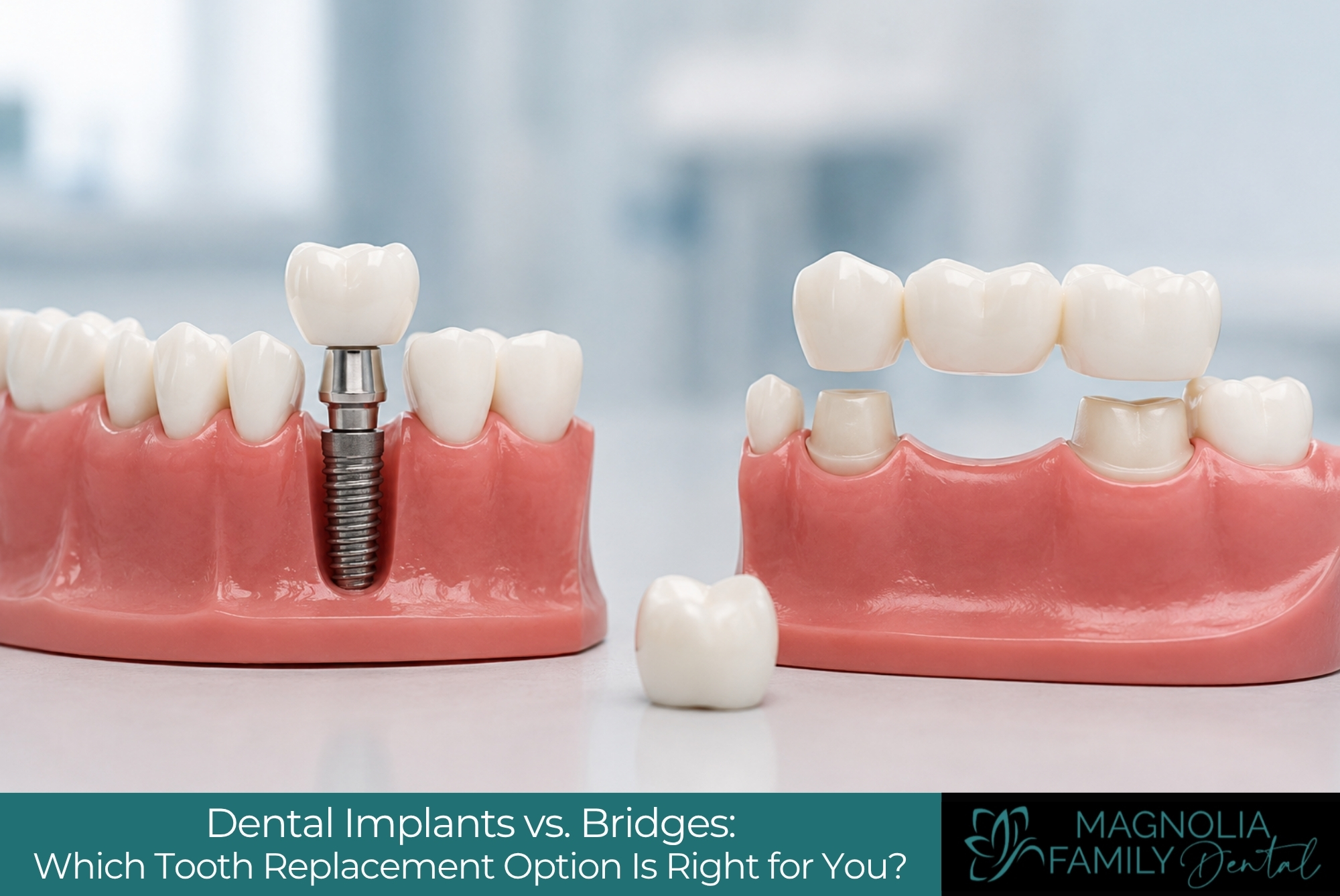
A dental implant is a small post placed into the jawbone to replace the root portion of a missing tooth. Once the implant has integrated with the surrounding bone, it can support a dental restoration such as a crown.
Unlike a traditional bridge, a single-tooth implant is independently supported and generally does not require neighboring teeth to be reshaped simply to support the replacement tooth.
Magnolia Family Dental describes dental implants as artificial tooth roots that support replacement crowns and notes that implant treatment typically involves several stages while the implant integrates with the jawbone.
How Does a Dental Implant Work?
Dental implants rely on a biological process known as osseointegration. During healing, bone develops a stable connection with the implant surface.
After sufficient healing has occurred, an abutment and customized restoration can be connected to the implant.
The completed restoration is designed to function similarly to a natural tooth while blending with the surrounding smile.
What Are the Advantages of Dental Implants?
One of the major benefits of an implant is that it replaces a missing tooth without depending on adjacent teeth for support.
Additional potential advantages include:
- Strong chewing function
- Natural-looking appearance
- Independent support
- Preservation of neighboring tooth structure
- Stimulation of the jawbone around the implant
- Long-term restorative potential
- Easier access between teeth compared with some traditional bridge designs
Implants can be an especially attractive option when the teeth next to the missing tooth are healthy and would otherwise need modification to support a conventional bridge.
What Is a Dental Bridge?
A traditional dental bridge replaces a missing tooth by creating a prosthetic tooth, called a pontic, that occupies the empty space.
The pontic is supported by crowns placed over teeth on either side of the gap. These supporting teeth are known as abutment teeth.
Magnolia Family Dental includes both bridges and dental implants among its restorative treatment options for Gainesville patients.
How Does a Traditional Bridge Work?
For a conventional bridge, the supporting teeth are prepared so that crowns can fit over them.
An impression or digital record is then used to create a restoration designed specifically for the patient’s bite and smile. The completed bridge is secured to the supporting teeth, with the artificial tooth positioned between them.
Because the teeth are connected as a single restoration, the bridge effectively spans the space created by the missing tooth.
What Are the Advantages of a Dental Bridge?
Dental bridges remain an important and effective restorative treatment.
Potential advantages include:
- No implant surgery
- Generally shorter overall treatment time
- Restoration of chewing function
- Improved smile appearance
- Prevention of an obvious gap
- Potentially appropriate treatment when adjacent teeth already need crowns
A bridge may be particularly reasonable when the teeth next to a missing tooth have large restorations or would benefit from crowns independently of the missing tooth.
Dental Implants vs. Bridges: What Are the Main Differences?
Although implants and bridges can produce similar cosmetic results, the underlying treatment approaches are significantly different.
Support
A dental implant receives its support from the jawbone.
A traditional bridge receives its support from neighboring teeth.
This distinction is one of the most important factors when comparing the treatments.
Effect on Neighboring Teeth
A single-tooth implant can usually replace a missing tooth without requiring the neighboring healthy teeth to be prepared for crowns.
A traditional bridge normally requires preparation of the supporting teeth.
For patients with completely healthy adjacent teeth, preserving that natural tooth structure may be an important reason to consider an implant.
Treatment Time
A bridge can often be completed faster because there is no waiting period for an implant to integrate with the jawbone.
Implant treatment generally requires a healing period. Magnolia Family Dental notes that integration of the implant with the jawbone may take approximately three to six months before subsequent restorative stages are completed.
Surgery
Dental implant placement involves a surgical procedure.
A conventional bridge typically does not require implant surgery, although other procedures may occasionally be necessary depending on the patient’s oral health.
Bone Preservation
Because an implant is positioned within the jawbone, it transfers functional forces to the surrounding bone.
A traditional bridge replaces the visible portion of the missing tooth but does not replace its root. Therefore, it does not provide the same direct stimulation to the bone beneath the missing tooth.
Cleaning and Maintenance
An individual implant-supported crown can typically be brushed and flossed in a manner similar to a natural tooth, although patients must pay careful attention to the gumline around the implant.
A bridge requires additional cleaning underneath the pontic. Floss threaders, interdental brushes, water flossers, or other recommended oral hygiene devices may help patients clean beneath the restoration.
Excellent oral hygiene is essential for the long-term health of either restoration.
Who Is a Good Candidate for Dental Implants?
Many adults with missing teeth can be considered for dental implants, but candidacy requires an individualized dental evaluation.
Factors your dentist may evaluate include:
- Overall health
- Gum health
- Jawbone quantity and quality
- Oral hygiene
- Smoking or tobacco use
- Medical conditions
- Medications
- Location of the missing tooth
- Bite forces
- Number of missing teeth
- Condition of surrounding teeth
Magnolia Family Dental notes that patients with healthy gums and adequate jawbone generally have favorable conditions for implant placement, although additional procedures may sometimes make implants possible for people who have experienced bone loss.
What If You Have Bone Loss?
Bone loss does not automatically mean dental implants are impossible.
Depending on the amount and location of bone loss, bone grafting or another preparatory procedure may sometimes be considered before implant placement.
The appropriate approach can only be determined after clinical examination and diagnostic imaging.
Who Might Benefit From a Dental Bridge?
A bridge may be a good choice for patients who:
- Want a nonsurgical tooth replacement
- Prefer a potentially shorter treatment timeline
- Cannot undergo implant surgery
- Have adjacent teeth that already require crowns
- Have anatomical limitations affecting implant placement
- Prefer a bridge after reviewing the benefits and limitations of each option
There is no universally superior tooth replacement for every patient. Treatment should be selected according to the condition of the entire mouth rather than the missing tooth alone.
How Long Do Dental Implants and Bridges Last?
Both restorations can provide many years of service, but longevity varies considerably among patients.
Factors affecting the lifespan of dental restorations include oral hygiene, gum health, bite forces, tooth grinding, smoking, diet, underlying health conditions, and regular professional dental care.
Implants are designed as a long-term tooth replacement solution. However, the crown attached to an implant can experience normal wear and may eventually require repair or replacement.
Bridges can also provide long-term function, but their success depends partly on the health of the supporting teeth.
Decay or periodontal disease affecting a supporting tooth can compromise an otherwise intact bridge.
For either restoration, consistent preventive dental care remains essential.
Which Option Looks More Natural?
Modern dental materials allow both implants and bridges to achieve highly aesthetic results.
The final appearance depends on several factors, including:
- Restoration material
- Tooth shape
- Tooth shade
- Gum contours
- Location of the missing tooth
- Condition of surrounding teeth and gums
- Quality of treatment planning
An implant-supported crown emerges independently from the gum area and can closely reproduce the appearance of an individual natural tooth.
A carefully designed bridge can also blend very naturally with neighboring teeth.
Which Option Feels More Like a Natural Tooth?
Many patients find an implant-supported restoration feels particularly natural because the replacement tooth is independently anchored.
Once the area has healed, an implant-supported crown is designed to remain stationary during chewing and speaking.
Bridges are also fixed restorations. Unlike removable dentures, they remain in the mouth during eating, sleeping, and normal daily activities.
Are Dental Implants Better Than Bridges?
Not necessarily.
Dental implants offer several important advantages, particularly when the adjacent teeth are healthy. However, “better” depends on the individual patient.
For example, an implant may be preferable when preserving healthy neighboring teeth is a priority.
A bridge might be preferable when neighboring teeth already require crowns or when a patient wants to avoid implant surgery.
The decision should be based on a comprehensive dental evaluation rather than one advantage alone.
What Happens During the Dental Implant Process?
Implant treatment typically occurs in stages.
Comprehensive Evaluation
Your dentist examines your teeth, gums, bite, and jawbone and reviews your medical and dental history. Diagnostic imaging may be necessary to evaluate bone anatomy and plan treatment.
Implant Placement
The implant is surgically positioned in the jawbone at the location of the missing tooth.
Healing and Osseointegration
The implant is given time to integrate with the surrounding bone.
Magnolia Family Dental states that this phase may take approximately three to six months.
Abutment and Restoration
After appropriate healing, an abutment connects the implant to the final restoration.
A customized crown is then created to restore the visible portion of the tooth.
What Happens During the Dental Bridge Process?
Bridge treatment usually begins by evaluating the missing tooth space and the teeth that will support the restoration.
The supporting teeth are prepared for crowns, and impressions or digital records are obtained.
A dental laboratory then creates the bridge according to the prescribed shape, size, shade, and bite relationship.
Once completed, the bridge is evaluated for fit and appearance before being secured into position.
What Happens If You Do Not Replace a Missing Tooth?
The consequences depend on which tooth is missing and the condition of the rest of the mouth.
Potential problems may include:
- Movement of adjacent teeth
- Changes in bite alignment
- Reduced chewing efficiency
- Increased stress on remaining teeth
- Changes in appearance
- Localized jawbone changes
- Food trapping
- Oral hygiene challenges
Not every missing tooth requires identical treatment, which is why a professional evaluation is important.
Dental Implants in Gainesville, FL: Restoring Your Smile at Magnolia Family Dental
If you’re researching dental implants in Gainesville, FL, Magnolia Family Dental provides comprehensive restorative dentistry designed around each patient’s individual needs.
The practice offers both dental implants and bridges, allowing patients to discuss multiple approaches to replacing missing teeth rather than relying on a one-size-fits-all solution.
The team can examine the missing tooth area, evaluate the health of neighboring teeth and gums, review available treatment options, and develop a personalized restorative plan.
Magnolia Family Dental provides general, cosmetic, and restorative dental services for patients of all ages in Gainesville and emphasizes a gentle, conservative approach to care.
Frequently Asked Questions About Dental Implants and Bridges
Are dental implants painful?
Implant placement is performed with appropriate anesthesia to help maintain comfort during treatment. Some tenderness, swelling, or soreness may occur afterward as part of normal healing. Individual experiences vary, and your dentist can explain what to expect based on your procedure.
How long does a dental implant take from start to finish?
The timeline varies depending on healing, bone health, whether grafting is necessary, and the complexity of the case. Magnolia Family Dental notes that integration of an implant with the jawbone may take approximately three to six months before later restorative steps are completed.
Can I get an implant immediately after losing a tooth?
Immediate implant placement is possible in selected cases, but it is not appropriate for everyone. Bone anatomy, infection, gum health, and the location of the tooth must all be evaluated.
Can I get dental implants if I have bone loss?
Possibly. Some patients with inadequate bone may be candidates for bone grafting or another preparatory procedure. A dental examination and appropriate imaging are necessary to determine your options.
Do dental implants get cavities?
The implant and artificial crown cannot develop tooth decay in the same way natural enamel can. However, the gums and bone surrounding an implant can develop inflammation or disease. Excellent brushing, interdental cleaning, and professional dental care remain essential.
Can a bridge get a cavity?
The artificial portion of a bridge cannot develop a cavity, but the natural teeth supporting the bridge can. Decay around a supporting tooth may threaten the entire restoration, making careful cleaning especially important.
Is it easier to clean a dental implant or a bridge?
A single implant-supported crown often allows cleaning between neighboring teeth more similarly to a natural tooth. Bridges require cleaning underneath the artificial tooth, often using specialized floss or interdental cleaning aids.
Will a dental bridge damage my healthy teeth?
A conventional bridge requires neighboring supporting teeth to be prepared for crowns. This involves removing some tooth structure. Whether that represents an appropriate tradeoff depends on the health of those teeth and the patient’s overall treatment needs.
Which lasts longer, a dental implant or a bridge?
Both can provide long-term service with appropriate care. Implant restorations have the advantage of not relying on adjacent natural teeth, while bridge longevity depends partly on the continued health of its supporting teeth. Individual outcomes vary.
Are implants better if the teeth next to the gap are healthy?
An implant may be particularly advantageous in this situation because the healthy adjacent teeth generally do not need to be prepared solely to support the replacement tooth.
Is a bridge better if the surrounding teeth already need crowns?
It may be. If the adjacent teeth require crowns for independent restorative reasons, incorporating them into a bridge may sometimes be an efficient treatment option. Your dentist must evaluate whether those teeth are suitable bridge supports.
Can dental implants replace more than one missing tooth?
Yes. Implant dentistry can be used in different configurations to replace one or multiple missing teeth. The number and positioning of implants depend on the patient’s anatomy and restorative needs.
Can older adults get dental implants?
Age alone does not necessarily determine implant candidacy. Overall health, oral health, bone condition, healing ability, medications, and other individual factors are generally more important considerations.
How do I decide between a dental implant and a bridge?
The decision should consider your bone health, gum health, condition of adjacent teeth, overall health, treatment timeline, budget, long-term goals, and willingness to undergo implant surgery.
A comprehensive dental evaluation provides the information necessary to compare your options accurately.
Where can I learn more about dental implants in Gainesville, FL?
Patients looking for dental implants in Gainesville, FL can schedule an evaluation with Magnolia Family Dental to discuss implant treatment, bridges, and other restorative options. The practice is located at 4121 NW 37th Place in Gainesville and can be reached at (352) 373-7361.
Choosing the Right Tooth Replacement for Your Smile
Dental implants and bridges can both successfully restore missing teeth, but they approach tooth replacement differently.
An implant replaces the missing tooth without relying on neighboring teeth for support and provides stimulation to the surrounding jawbone. A traditional bridge offers a fixed, nonsurgical solution that can often be completed more quickly and may be particularly appropriate when neighboring teeth already require crowns.
The right choice depends on your individual oral health—not simply which treatment is newer or more popular.
If you are considering dental implants in Gainesville, FL, the team at Magnolia Family Dental can evaluate your smile and explain the advantages, limitations, and expected treatment process for your available tooth replacement options.
Contact Information
Magnolia Family Dental
4121 NW 37th Place
Gainesville, FL 32606
Phone: (352) 373-7361
Website: magnoliafamilydental.com
Appointments: magnoliafamilydental.com/appointments/
Magnolia Family Dental’s current website confirms the Gainesville address and phone number listed above.