
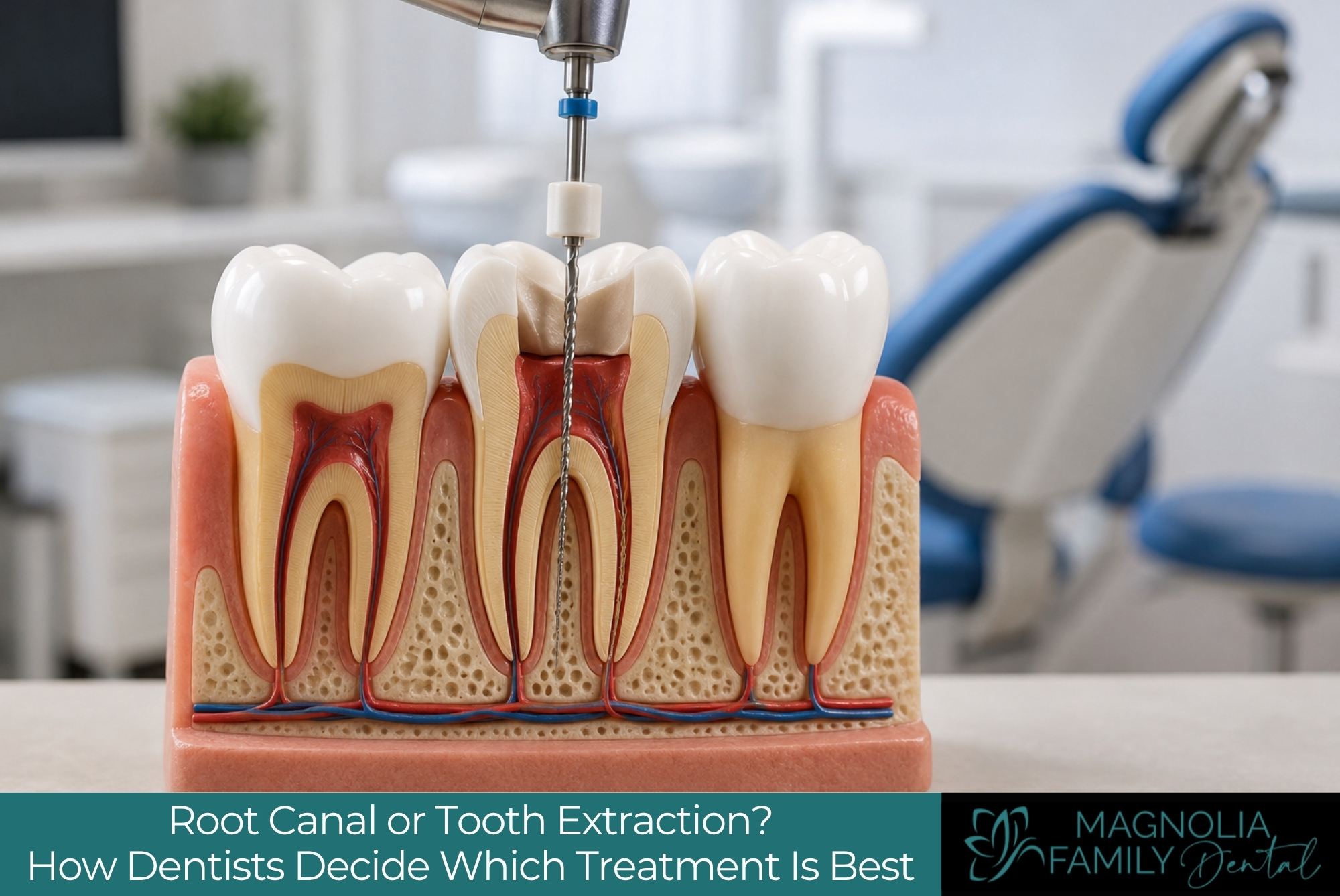
When a tooth becomes severely damaged, infected, or painful, patients are often faced with an important question: Can the tooth be saved with a root canal, or does it need to be extracted? Although both treatments can eliminate infection and relieve dental pain, they accomplish very different goals.
At Magnolia Family Dental, the priority is generally to preserve a natural tooth whenever doing so offers a predictable, healthy, long-term result. However, there are situations in which removing a tooth is the safer or more practical treatment.
If you are experiencing significant tooth pain and searching for information about a root canal in Gainesville, FL, understanding how dentists evaluate an affected tooth can help you feel more prepared for your appointment.
What Is the Difference Between a Root Canal and a Tooth Extraction?
A root canal treatment and a tooth extraction can both be used to address severely compromised teeth, but the fundamental difference is whether the natural tooth remains in your mouth.
Root Canal Treatment Preserves the Natural Tooth
Root canal therapy, also known as endodontic treatment, is designed to save a tooth when the pulp inside it has become inflamed, infected, or necrotic.
The dental pulp is the soft tissue inside the tooth containing nerves, blood vessels, and connective tissue. When bacteria reach this tissue through deep decay, cracks, fractures, or trauma, inflammation and infection can develop.
During root canal treatment, the affected pulp is removed. The inside of the tooth is then carefully cleaned, disinfected, shaped, and sealed. Depending on the tooth and the amount of remaining structure, a dental crown may subsequently be recommended to strengthen and protect it.
Tooth Extraction Removes the Entire Tooth
An extraction involves removing the tooth from its socket.
Extraction may become necessary when a tooth is so severely damaged that it cannot be predictably restored or when keeping the tooth could compromise surrounding tissues.
After an extraction, your dentist may discuss tooth replacement options such as a dental implant, bridge, or removable prosthesis, depending on the location of the missing tooth and your individual needs.
Why Dentists Usually Prefer to Save Natural Teeth
When clinically appropriate, preserving a natural tooth has several advantages.
Your teeth are designed to work together as a functional system. Each tooth contributes to chewing, speech, bite stability, and the maintenance of normal spacing between neighboring teeth.
Saving a tooth with root canal treatment may help preserve:
Natural chewing function
Normal bite relationships
The position of neighboring teeth
Jawbone stimulation around the tooth
Your natural appearance
The need for more extensive tooth-replacement procedures may also be avoided.
However, preserving a tooth is beneficial only when that tooth has a reasonable prognosis. A dentist will not typically recommend root canal therapy simply to delay an extraction if the tooth cannot be restored successfully.
How Dentists Decide Between a Root Canal and an Extraction
Choosing the appropriate treatment requires more than determining whether a tooth hurts. Your dentist evaluates the tooth itself, surrounding tissues, supporting bone, gums, bite, and overall oral health.
1. Is the Tooth Restorable?
One of the most important questions is whether enough healthy tooth structure remains to rebuild and protect the tooth.
A tooth may have infected pulp but still possess enough healthy structure for successful root canal treatment followed by an appropriate restoration.
In contrast, a tooth with extensive structural destruction may not provide enough support for a predictable restoration.
2. How Deep Is the Decay?
Dental decay begins in the outer layers of a tooth and can gradually progress toward the pulp.
If decay reaches the pulp, root canal therapy may be required to save the tooth. However, extremely extensive decay—particularly decay extending significantly beneath the gumline—can make restoration difficult or impossible.
The location and extent of decay therefore play an important role in treatment planning.
3. Is the Tooth Cracked or Fractured?
Not every cracked tooth needs extraction.
Some cracks can be managed with restorative treatment, while others may require root canal therapy and a crown.
The prognosis changes significantly when a crack extends deeply through the tooth or root. Certain vertical root fractures, for example, can make predictable preservation of the tooth impossible.
Your dentist must determine where the fracture begins, how far it extends, and how much healthy tooth structure remains.
4. What Is the Condition of the Supporting Bone and Gums?
A healthy tooth requires healthy supporting tissues.
Even if root canal treatment could eliminate infection inside a tooth, severe periodontal disease may leave the tooth without adequate bone support.
Dentists therefore evaluate factors such as:
Gum health
Periodontal pocket depth
Bone levels
Tooth mobility
Signs of periodontal infection
Long-term stability
A severely mobile tooth with extensive bone loss may have a poor prognosis even if its internal infection could technically be treated.
5. Has the Infection Spread?
Dental infections can extend beyond the pulp and into tissues surrounding the root.
Dentists may use dental X-rays and other diagnostic information to evaluate changes in the bone around a tooth’s roots.
An infection around the root does not automatically mean the tooth needs to be extracted. Root canal treatment is specifically designed to eliminate the source of many infections originating inside teeth.
The important question is whether the infection can be adequately treated while preserving a structurally sound and functional tooth.
6. Has the Tooth Had Previous Root Canal Treatment?
Occasionally, a tooth that previously received root canal treatment develops new symptoms or infection.
This does not necessarily mean extraction is required. Depending on the circumstances, root canal retreatment or another endodontic procedure may be possible.
The dentist will consider the cause of the problem, the condition of the existing restoration, remaining tooth structure, root anatomy, and overall prognosis.
Signs You May Need a Root Canal
Symptoms vary considerably. Some teeth requiring root canal treatment cause significant pain, while others produce surprisingly few symptoms.
Possible warning signs include:
Persistent toothache
Pain when chewing or biting
Prolonged sensitivity to hot or cold temperatures
Swelling around a tooth
Tender or swollen gums
A recurring pimple or bump on the gum
Darkening or discoloration of a tooth
A cracked or severely damaged tooth
Lingering discomfort after temperature exposure
It is important to understand that symptoms alone cannot confirm whether you need root canal therapy. A professional examination is necessary.
Can You Need a Root Canal Without Having Severe Pain?
Yes.
One common misconception is that a tooth requiring root canal treatment must cause intense pain. In reality, the nerve tissue inside an infected tooth can eventually die, potentially reducing sensitivity even though infection remains.
For this reason, the absence of severe pain does not necessarily indicate that a tooth is healthy.
Routine dental examinations and diagnostic imaging can sometimes reveal problems before significant symptoms develop.
What Happens During Root Canal Treatment?
Understanding the procedure can help reduce uncertainty for patients considering a root canal in Gainesville, FL.
Examination and Diagnosis
Your dentist first evaluates the tooth and your symptoms. Dental X-rays may be taken to assess the roots and surrounding bone.
Additional diagnostic tests may evaluate temperature sensitivity, biting discomfort, tenderness, or pulp vitality.
Local Anesthesia
The area is numbed with local anesthetic to keep you comfortable during treatment.
Accessing the Tooth
A small opening is created so the dentist can reach the pulp chamber and root canals.
Removing Infected or Damaged Tissue
The inflamed, infected, or dead pulp tissue is carefully removed.
Cleaning and Shaping the Canals
Specialized instruments are used to clean and shape the root canal system.
Sealing the Tooth
After cleaning and disinfection, the canals are filled and sealed with dental materials designed for endodontic treatment.
Restoring the Tooth
The tooth then requires an appropriate restoration.
Because teeth requiring root canals frequently have substantial decay, fractures, or structural weakening, a dental crown may be recommended—particularly for posterior teeth that experience significant chewing forces.
Is a Root Canal Painful?
Modern root canal therapy is performed using local anesthesia, and its purpose is to eliminate the diseased tissue responsible for dental pain.
Patients may experience tenderness or sensitivity following treatment, especially if significant inflammation or infection was present beforehand. This discomfort generally improves as the surrounding tissues heal.
Severe or worsening symptoms following treatment should be reported to your dental provider.
When Is Tooth Extraction the Better Choice?
Although preserving natural teeth is often desirable, extraction may provide the better prognosis in certain circumstances.
A dentist may recommend extraction when:
The tooth cannot be predictably restored
Decay has destroyed too much tooth structure
A fracture extends too deeply into the tooth or root
Severe periodontal disease has compromised supporting bone
The tooth has extreme mobility
Repeated treatment has failed and additional treatment has a poor prognosis
Restoring the tooth would not provide reasonable long-term function
The decision should be based on the overall condition and prognosis of the tooth rather than simply choosing the quickest treatment.
What Happens After a Tooth Extraction?
Removing a tooth solves one problem but may create another: an empty space in the dental arch.
Depending on the tooth’s location and your individual circumstances, leaving the space untreated may allow neighboring teeth to shift or affect chewing and bite relationships.
Your dentist may therefore discuss replacement options.
Dental Implants
A dental implant is surgically placed into the jawbone and can support a crown that replaces the missing tooth.
Dental Bridges
A traditional dental bridge replaces a missing tooth by using neighboring teeth for support.
Removable Tooth Replacements
Partial dentures and other removable prosthetic options may be appropriate when one or multiple teeth are missing.
Not every extracted tooth necessarily requires replacement. Wisdom teeth, for example, are generally not replaced. Your dentist can determine whether replacement is appropriate based on the specific tooth and your overall oral health.
Root Canal vs. Extraction: Comparing Long-Term Considerations
When deciding between treatment options, patients understandably consider cost, treatment time, comfort, and longevity.
However, comparing only the immediate procedures can be misleading.
Root Canal Treatment
A successful root canal allows you to retain your natural tooth. Additional restorative treatment, such as a crown, may be necessary.
Extraction
Extraction removes the problematic tooth, but treatment may not end there. If replacing the tooth is recommended, the total treatment plan could include an implant, bridge, or removable prosthesis.
For this reason, patients should consider the complete treatment plan rather than comparing only the initial cost of a root canal with the initial cost of extraction.
Why Delaying Treatment Can Make the Problem Worse
Dental infections and severe decay generally do not resolve without professional treatment.
Waiting may allow decay to destroy additional tooth structure or permit infection and inflammation to progress.
A tooth that could potentially be saved today may become more difficult—or impossible—to restore after substantial additional damage.
Prompt evaluation is particularly important if you develop:
Facial swelling
Significant gum swelling
Fever associated with dental symptoms
Severe or rapidly worsening pain
Difficulty swallowing
Difficulty breathing
Spreading swelling
Difficulty opening your mouth
Symptoms involving breathing or swallowing require urgent medical attention.
How Dentists Diagnose an Infected Tooth
Accurate diagnosis is essential because tooth pain can have several causes.
Dentists combine multiple sources of information rather than relying on one symptom.
Clinical Examination
The dentist examines the tooth for cavities, fractures, damaged restorations, swelling, discoloration, and other abnormalities.
Dental X-Rays
X-rays can reveal deep decay, changes around the roots, bone loss, and other conditions that may not be visible during a clinical examination.
Sensitivity Testing
Temperature or other pulp tests may help determine whether the nerve tissue is healthy, inflamed, or nonvital.
Percussion and Biting Tests
Gentle pressure, tapping, or biting tests can help determine whether tissues surrounding a tooth’s root are inflamed.
Periodontal Evaluation
The gums and supporting structures are examined because periodontal disease and fractures can sometimes produce symptoms similar to endodontic problems.
The combined findings help the dentist determine the most appropriate treatment.
Can Antibiotics Replace a Root Canal?
Usually, no.
Antibiotics can be useful in specific circumstances involving spreading bacterial infection or systemic involvement, but they generally do not eliminate the underlying source of infection inside a compromised tooth.
When infected or necrotic pulp is responsible for the problem, definitive dental treatment—such as root canal therapy or extraction—is typically required.
Unnecessary antibiotic use should also be avoided because inappropriate antibiotic use contributes to antimicrobial resistance.
Why Early Dental Evaluation Matters
One of the strongest arguments for seeking care promptly is that early treatment can preserve more options.
A small cavity may initially require only a filling.
As decay progresses, the tooth may require a larger restoration.
If bacteria reach the pulp, root canal treatment may become necessary.
If extensive destruction continues, the tooth may eventually become non-restorable and require extraction.
Therefore, addressing dental problems early is often simpler than waiting for pain to become severe.
Choosing Root Canal Treatment in Gainesville, FL
If you are experiencing tooth pain, sensitivity, swelling, or other symptoms, the goal should not simply be to determine whether you need a root canal. The goal is to receive an accurate diagnosis and choose the treatment that offers the best combination of health, function, and long-term predictability.
At Magnolia Family Dental, patients can receive a comprehensive evaluation to determine whether a damaged or infected tooth can be preserved.
For patients searching for a root canal in Gainesville, FL, an examination is the first step toward understanding the cause of the problem and determining whether root canal therapy, extraction, restorative treatment, or another approach is most appropriate.
Frequently Asked Questions About Root Canals and Tooth Extractions
Is it better to get a root canal or pull the tooth?
If a tooth can be predictably restored, preserving it with root canal treatment is often preferable because it maintains your natural tooth. Extraction may be recommended when the tooth is too damaged, fractured, unstable, or otherwise unable to provide reliable long-term function.
How does a dentist know if I need a root canal?
Dentists evaluate your symptoms, examine the tooth, assess the gums and surrounding tissues, and may use X-rays and pulp testing. The diagnosis depends on the condition of the dental pulp and whether the tooth can be successfully restored.
Does an infected tooth always need to be extracted?
No. Many infected teeth can be treated successfully with root canal therapy. Extraction is generally considered when preserving the tooth is not clinically predictable or appropriate.
Can a badly decayed tooth still be saved?
Sometimes. The deciding factor is not simply how large the cavity appears. Dentists evaluate how much healthy tooth structure remains and whether the tooth can be adequately restored after decay and infection are treated.
Can a cracked tooth have a root canal?
Yes, depending on the location and extent of the crack. Some cracked teeth can be treated with root canal therapy and a crown. Deep fractures extending through the root can significantly reduce the likelihood that the tooth can be saved.
What happens if I don’t treat an infected tooth?
Untreated infection may progress, potentially causing increasing pain, swelling, bone changes, or an abscess. Delaying treatment may also reduce the possibility of preserving the tooth.
Will antibiotics cure my infected tooth?
Antibiotics alone generally cannot eliminate infection originating from diseased or dead pulp inside a tooth. Definitive dental treatment is usually required to address the source.
Will I need a crown after a root canal?
Many teeth benefit from crowns after root canal treatment, particularly molars and premolars that withstand substantial chewing forces. The appropriate restoration depends on the location of the tooth and how much healthy structure remains.
How long does a root canal-treated tooth last?
A properly treated and restored tooth can remain functional for many years. Longevity depends on factors including remaining tooth structure, the quality of the restoration, oral hygiene, bite forces, periodontal health, and future dental disease.
Is extraction cheaper than root canal treatment?
The initial cost of extraction may sometimes be lower, but the complete financial comparison should include potential tooth replacement. An implant, bridge, or other prosthetic treatment can add additional procedures and costs.
What should I do if my tooth suddenly starts hurting?
Contact a dentist promptly for an evaluation. Severe pain, swelling, fever, facial swelling, or rapidly worsening symptoms warrant timely attention. Difficulty breathing or swallowing requires urgent medical care.
Can I choose extraction even if the tooth can be saved?
Patients should discuss the benefits, disadvantages, prognosis, costs, and long-term consequences of each option with their dentist. Treatment decisions should be made after understanding both the immediate procedure and the consequences of losing the natural tooth.
How quickly should I see a dentist if I think I need a root canal?
Schedule an evaluation as soon as reasonably possible. Dental problems are generally easier to manage before extensive additional damage or infection develops.
Where can I get evaluated for a root canal in Gainesville, FL?
Patients experiencing tooth pain or symptoms of a damaged or infected tooth can contact Magnolia Family Dental in Gainesville, Florida, to schedule an evaluation and discuss appropriate treatment options.
Protect Your Natural Smile With Prompt Dental Care
The decision between a root canal and tooth extraction is not based on a single symptom or X-ray finding. Dentists consider the health of the pulp, amount of remaining tooth structure, presence of cracks or fractures, periodontal support, infection, restorative possibilities, and expected long-term prognosis.
When a tooth can be predictably saved, root canal therapy can eliminate diseased pulp while allowing the natural tooth to remain functional. When damage is too extensive, extraction may provide a healthier and more predictable solution.
If you are experiencing tooth pain or believe you may need a root canal in Gainesville, FL, don’t wait for the problem to become more severe. A professional dental evaluation can identify the cause and determine which treatment offers the best opportunity for long-term oral health.
Contact Information
Magnolia Family Dental
4121 NW 37th Place
Gainesville, FL 32606
Phone: (352) 373-7361
Website: magnoliafamilydental.com
Appointments: magnoliafamilydental.com/appointments/